Unfinished journeys
Is it time to stop reading?

Last week a friend enthusiastically encouraged me to read two books they’d found insightful. One of the titles seemed familiar; turning to the bookcase next to me I found a slightly dusty copy. That explained the familiarity. And as I pulled the book from the shelf I noticed a train ticket acting as a makeshift bookmark. Which triggered a pang of guilt. Because I have a dark secret…
I like books. I have lots of them. I am surrounded by shelves of books. They spill out of my study and into the spare bedroom, the hall, the kitchen. I have more boxes of them in the attic. But I’m less good at reading them. Particularly business/ professional development books.
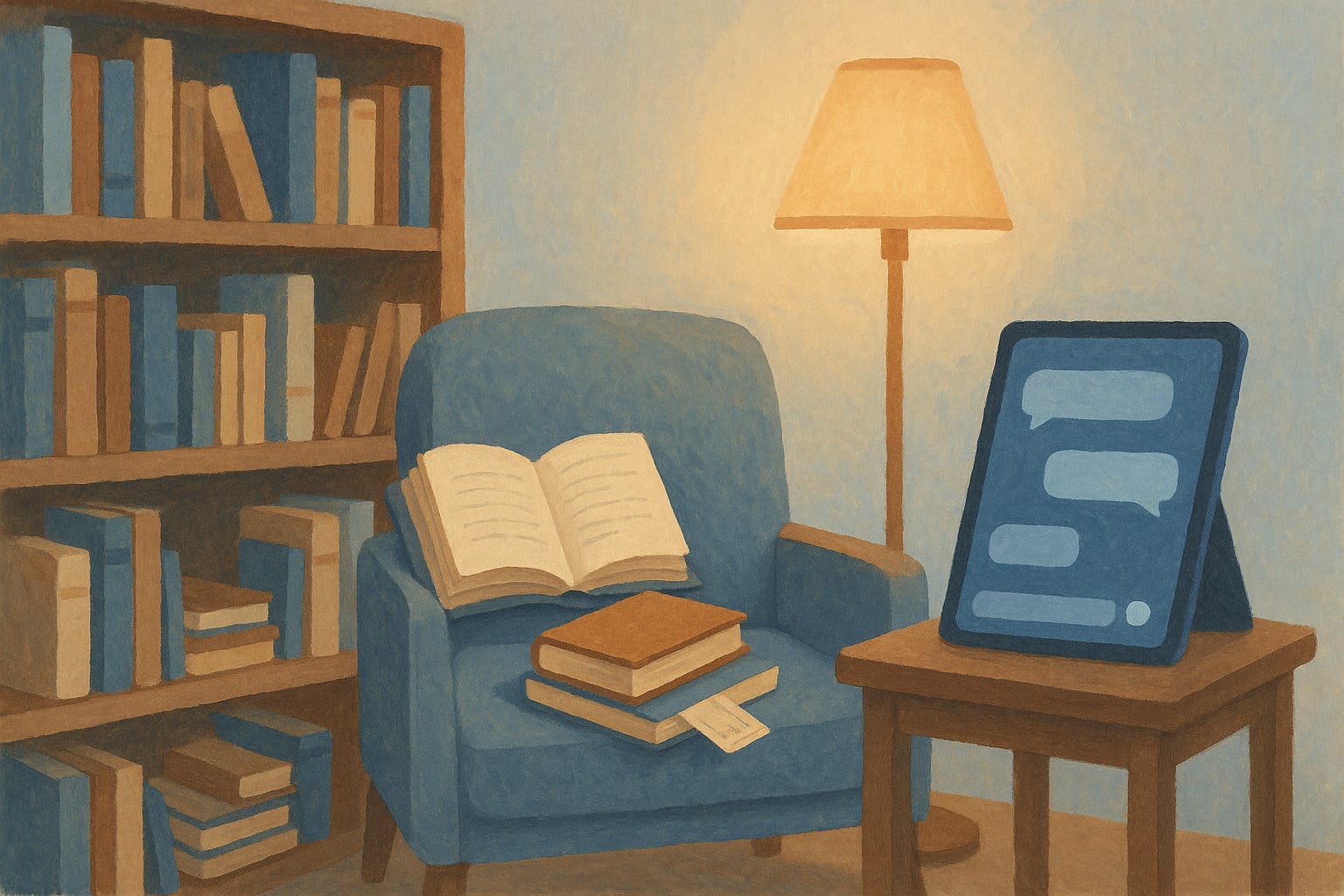
Over the years I’ve noticed I have a pattern. I’ll be going on a trip. And I’ll pack a professional development book. I’ll read it while I’m travelling. But invariably I won’t finish it before I get home. And so the book ends up back on the shelf - complete with train ticket or boarding pass. A sad reminder of how, yet again, I failed to finish a book.
Months later I’ll be packing for another trip. I’ll look at the partly read book. And realise I’ve forgotten most of what I read. I’m not alone here. Back in the 1880s, psychologist Hermann Ebbinghaus introduced the concept of the forgetting curve - the loss of memory with time. The curve shows a rapid decline in memory retention shortly after learning, levelling off over time. After about 30 days, only 20% of new information is retained. I wrote about this last October, but you’ll likely have forgotten it...
And that’s (one of) my dark secrets. I’m hopeless at finishing books.
The problem with books
But there’s another problem with books. Especially professional development books. Expectations. If we buy a book we expect it to be a particular length. We want to feel we’re getting value for money.
And how do we measure value? Reviews. And size. We expect a book to have 75 thousand words. To be several hundred pages in length. Otherwise how can it possibly convey anything valuable?
Yet many of these books have a handful of key messages. Which are then repeated. And padded. Just to meet our expectations of what a book should be. To make us feel we’re getting a good deal.
I call this Signal-to-Noise Ratio (SNR). Many of the professional development books I’ve read have a low SNR. Sure, they contain nuggets of advice. But there are better ways to spend my time. And these days I no longer need to actually read the book to get the nuggets. I can listen to audiobooks. Watch YouTube summaries. Listen to podcasts. Go to bookclubs.
And, of course, there’s AI as well.
Quizzing real-time voice
AI opens the door to a more interactive summary. It offers summaries of the books. And you can then discuss those. Discuss the bits that don’t make sense. Figure out how to apply the advice to your world. It offers something we’ve never had before.
And that’s what I did with the two books my friend had recommended. Over the course of a 30 minute walk, I discussed them with ChatGPT real-time voice. It was an interesting experience.
The initial summary was too lightweight - trying to summarize the entire book in two sentences doesn’t work. So more detail needed upfront - and try as I might I couldn’t figure out a way to get ChatGPT to talk at length. Real-time voice just doesn’t seem to want to lecture.
But as I asked more questions, the conversation started to pivot from a summary of the book into a discussion of the concepts. An interesting discussion. And ChatGPT could go and get feedback from other users - pull in other viewpoints and make the discussion richer and more involving. I could discuss how to apply the nuggets from the book to my life. Ponder them in real time and discuss them. It was more effective. And more efficient.
Which leads to a question - should you read books anymore?
If it’s for pleasure then absolutely. But professional/ technical development books? I think their days are numbered. AI offers a more effective way to consume the advice. A more effective way to apply the advice. And it takes less time.
Authors should still write. But their audience is changing. Increasingly they are writing for the AI models, not humans. Making money through writing is already nigh on impossible. This doesn’t make it any easier. AI is also likely to weaken alternate revenue streams such as lectures, podcasts, YouTube videos.
The one thing AI is likely to do is make it easier to surface and spread ideas (assuming they are in the training data). But it will weaken the financial reward for creating and spreading those ideas.
But do we lose anything?
We gain effectiveness and efficiency, yet I can't help but wonder what we might be losing. Those dog-eared pages sometimes contain unexpected treasures - ideas that weren't the "main point" but resonated uniquely with us. The metaphor buried deep in the text that perfectly crystallised a complex concept. The notes the previous owner scribbled in the margin.
There's also something to be said for the slow digestion of ideas. Living with ideas over days or weeks sometimes allows for connections and insights that a 30-minute summary simply can't replicate. The author's voice and perspective permeate more deeply when we spend extended time with their work.
Maybe AI can help as an initial filtering mechanism, enabling us to better understand which books deserve our full attention and which can be condensed to nuggets of wisdom. Maybe as AI models get to know us they’ll be able to recommend and advise us what to read? And then discuss ideas and practical applications?
What I know for certain is that train tickets make terrible bookmarks. They curl at the edges, fall out easily, and serve as persistent reminders of my dark secret. And yet, I'll probably slip another one between pages on my next trip - because old habits die hard, even in this brave new AI world.