The setting sun
Out of the silo and into the sandbox

It’s nearly 30 years since I first led a software engineering team. We were building a video conferencing product - SunForum - for Sun Microsystems. Back then Sun dominated enterprise computing; much like Apple today they provided hardware and software. If you wanted reliability and performance at a reasonable price you bought Sun. Their kit powered much of the early internet. Their stock climbed exponentially as the internet took off.
On one level SunForum was a just a port of NetMeeting to Solaris. But on another it was an amazing chance to work on a technology whose time had surely come. We had the internet now - video calling was inevitable, wasn’t it?
History, of course, had other ideas. The dot-com bubble killed Sun. It took twenty years - and COVID - for video conferencing to become ubiquitous.
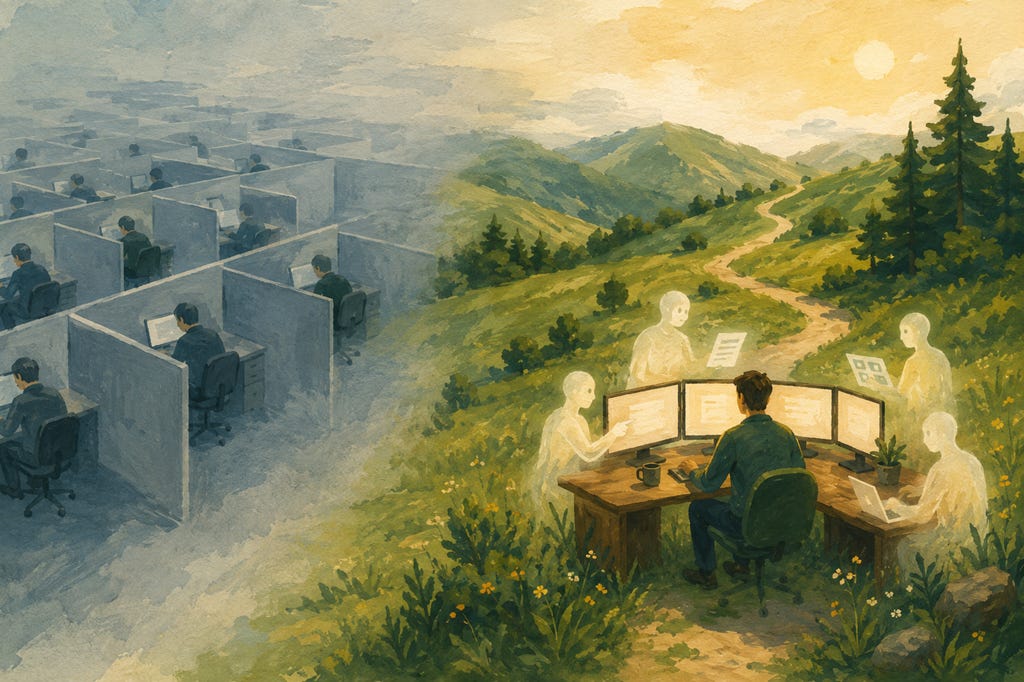
Software engineering was different back then. We were a multidisciplinary team. We architected, designed, implemented, tested, supported. We did product management and technical sales. When I visited Sun in Palo Alto we’d hold a project meeting in the morning, talk technical sales over lunch and do training in the afternoon. It didn’t seem unusual - it was just how it was.
Over the years specialisation has resulted in increasing functional silo-ing. We have dedicated architecture teams. Dedicated support, product mgmt, technical sales. Conventional wisdom tells us this is how software engineering works best. And it does. Mostly.
But now we’re adding AI. And most orgs are treating AI like any previous tech. Adopting an additive approach, just like they did with micro services. Or cloud. Or agile.
I get that; it’s a pattern that worked before. Why won’t it work now?
AI is different
But it’s becoming clear AI is different. It’s not additive. It’s structurally disruptive. Getting the most from AI requires rethinking everything. Everything.
Much of the software dev process is anchored on the expense of building code. Rightly so. Writing code is - was - incredibly expensive. AI makes it cheap. How does that change things?
Suddenly it’s cheap to experiment. It’s OK to create 10kloc as an experiment. And then throw it away. One of my projects is on its fifth incarnation. I build. I learn. I start over. It’s not an easy mindset shift to make - the know-what-you’re-going-to-build-before-you-build-it mantra is deeply ingrained in me.
Product management changes. No longer does it need to be hyper-focused on ensuring the dev team builds exactly the right thing. It can be looser. I share product management with my co-founders. They have imprecise (vague, even?) high-level ideas; I paint the detail. If we don’t like the detail - or the idea - we throw it away. The line between product management and engineering moves.
Or consider human context management. All engineers know the cost of interruptions; it can easily take 15 minutes to recover from a poorly timed interruption. Except it gets worse with AI; I’m juggling so many plates it can easily take an hour to recover from an interruption. It’s more important than ever to remain in the flow.
Or consider the working day. 9-5 is suboptimal for AI; you can achieve far more if you are flexible and make yourself available to unblock and redirect your agent team. My work day is quite different; I start at 6 to see what the team has been up to overnight. After an hour of redirecting them, I go for a walk in the hills and am back with them by 9. I often have a nap in the afternoon (biphasic and polyphasic sleeping seems increasingly common amongst those using AI extensively). Then I work with them on and off during the afternoon and evening. And I always check-in before I go to bed.
Or consider kit. I’ve got three top end servers in my lab. I could happily use another couple. They need to be desktops - laptops just don’t have the cooling to cope with the constant load from constant compile/link/debug cycles. They need to have good quality NVMe drives with long lives (I’ve already worn out one cheap NVMe drive - Rust is a drive killer). They’ll also need to go and live in the workshop over summer - it’s currently 27C in my lab…
The way our team works is different - Qing coined the phrase "sandboxed experimentation". I think that sums up what we’re doing beautifully.
And so?
Right now I’m doing architecture, engineering, team-leadership and ST. I’m back to being multi-disciplinary. I don’t think it’s possible to get the most from AI unless you embrace this.
But if you do then you enter a strange world. I’ve published nine Rust crates so far this year. Roughly 30 years worth of old-world development. Never-mind the other projects - the things I’m working on with my co-founders which double that number. ~150 years of old-world development in a year seems plausible. And bonkers.
And remember there’s a double saving. You save because AI is faster. And you also save because you don’t pay the co-ordination tax (in any team ~30% of the resource is spent on cross-team comms & co-ordination).
But the increasing specialisation over the past few decades presents a problem for AI adoption. How many people are multi-disciplinarians? Specialized knowledge of Python is not the skill set you need to thrive now. It seems likely many engineers have the wrong skill set. Or worse, an increasingly useless skill set.
And silo’d orgs? Well, they’re a problem too. The silos that enabled orgs to prosper when code was expensive to write now limit their ability to adopt AI. The silos actively discourage - prevent - multi-disciplinarian. The very thing you need to get the most from AI.
We’re in a period of flux. It’s clear the old ways are wrong. Structures and roles will change. But it’s not yet clear what the new org structures, the new roles, the new SDLC will be. Which is why sandboxed experimentation matters so much - right now orgs need to be creating multi-disciplinary teams and putting them in a sandbox. Watching. Learning. And then working out how to migrate the old org structures to the new.
Without this? Well, you might be joining Sun in the list of forgotten companies.