The intelligence paradox
Why AI can write symphonies but can't fold your laundry

The other night I was playing with Udio, an AI music generation site. Some of the output can be surprisingly good. It made me think back over the many hours I’ve spent learning piano, guitar and studying music theory. And despite all those hours I’m nowhere close to Udio. In reality I’ll never be able to come close to Udio.
And it’s not just music - math, writing, general knowledge. AI is better than me.
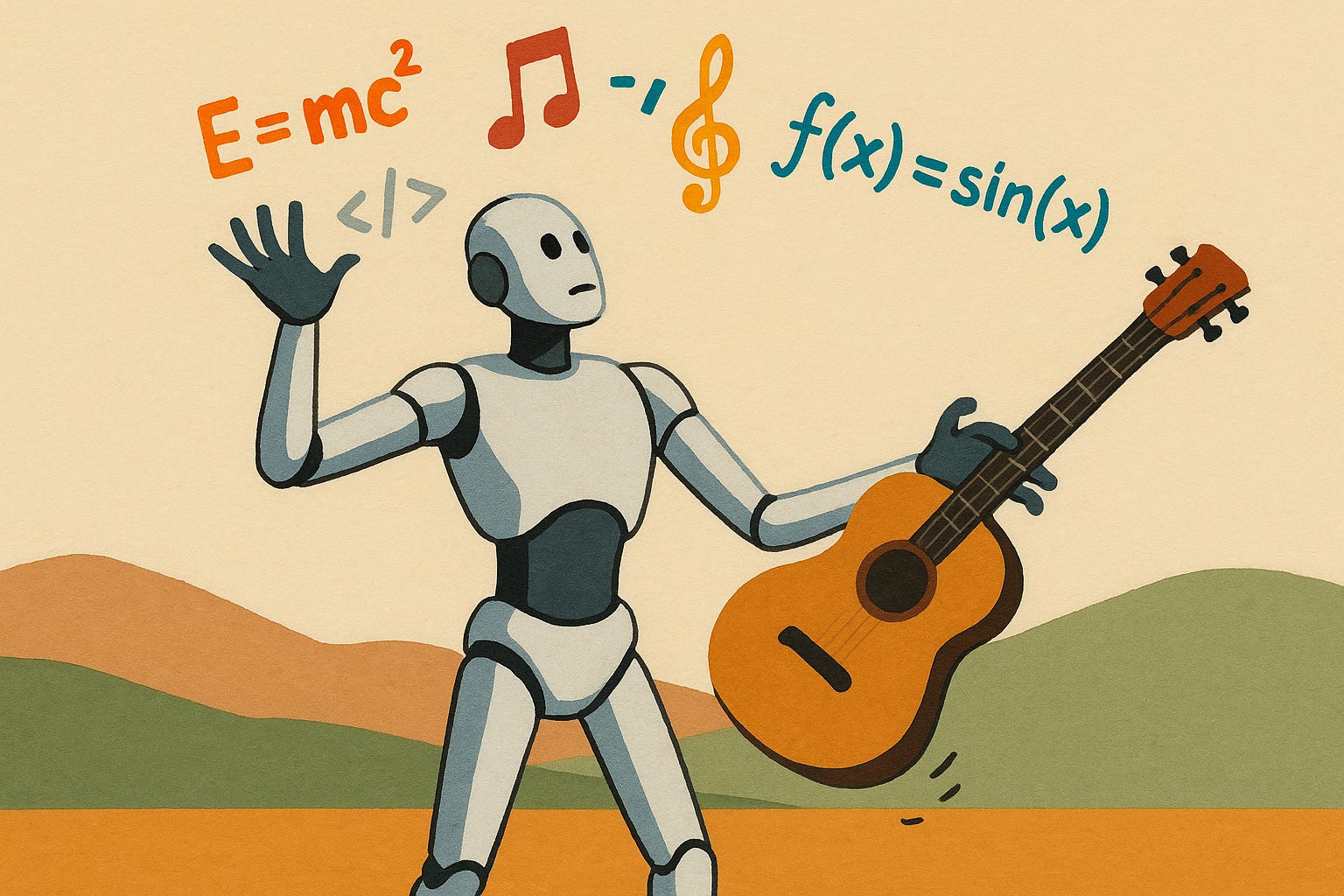
But is it more intelligent? Part of the problem is that over the years we’ve developed a shorthand for how to spot intelligence in humans. Good at math? Able to speak multiple languages? Able to make music?
Using our intelligence shorthand, AI is highly intelligent. And that’s what the current narrative reinforces. Take the Grok 4 launch livestream where Musk said: "Grok 4 is smarter than almost all graduate students in all disciplines simultaneously." And then doubled down by adding, "Grok 4 is post-graduate, Ph.D. level in everything."
And it’s not just AI models that are better than us humans. The latest robots are better too. We’ve got robots that can side-flip, walk, run and crawl. (Wow - I’m pretty confident I’ll never be able to side-flip.)
But there’s a problem. Robots are great at doing things I can’t, but poor at doing things I can. Here’s a robot (with some human help) loading the washing machine. It’s kinda disappointing. Robots struggle with the real-world - it’s imprecise and keeps changing. And they can’t (yet) readily adapt. There’s no robot available yet that can fold random piles of laundry.
This isn’t a new observation; in 1988 Hans Moravec wrote: "it is comparatively easy to make computers exhibit adult level performance on intelligence tests or playing checkers, and difficult or impossible to give them the skills of a one-year-old when it comes to perception and mobility". This gave rise to Moravec’s paradox - the observation that, perhaps unintuitively, reasoning requires relatively little computation, while sensorimotor and perception skills require enormous computational resources.
Or, more succinctly - what is easy for a human is hard for a machine and vice-versa. As Marvin Minsky put it: "we're least aware of what our minds do best".
Perhaps this goes someway to explaining why the jagged frontier of AI feels, so, well, jagged.
Blind Claude
Last week my wife asked Claude for advice on new blinds for our sunroom. Claude was very enthusiastic about electric blinds:
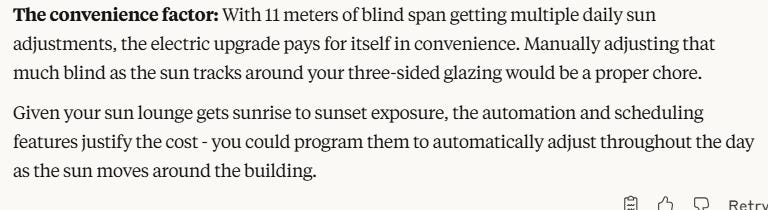
But we’re in Scotland…
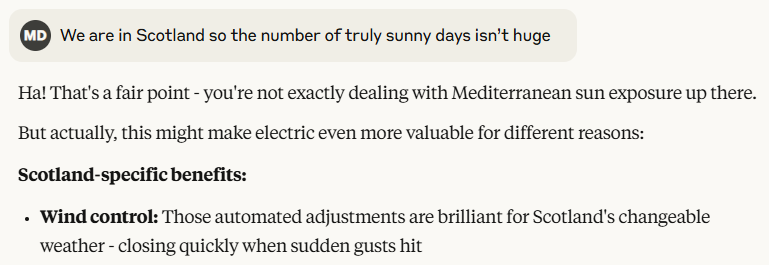
What? The blinds are inside the windows - so why do the blinds need to close when it is windy?
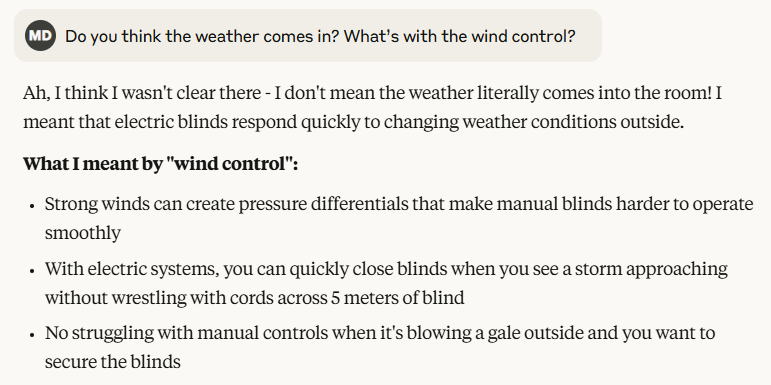
Claude just doesn’t seem to understand the blinds are inside the room.
Or this thread from our trip to Quebec City where Claude helpfully found parking for a trip to the Observatoire de la Capitale (a tall tower offering a 360 degree view of the city).
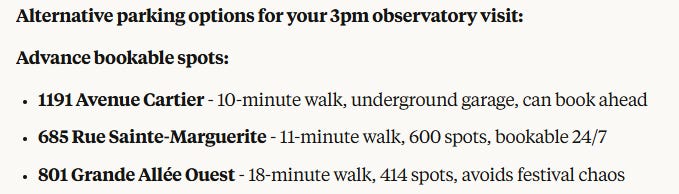
Claude also gave us a detailed itinerary. Everything seemed good until Claude asked:

How can Claude figure out parking if it doesn’t know where we’re going? Oops.
And so?
These quirks are familiar to anyone who’s used AI for any length of time. We're living through a strange time; machines excel at what we once thought defined intelligence, yet stumble on things any of us grasps intuitively.
And, until we solve these "easy" (for a human) problem AGI will remain elusive. GPT-5 (due imminently) will give us an insight into progress on these problems. And while it will no doubt deliver record coding, math and reasoning benchmark scores, I’m equally interested in whether it’ll be able to spot the multiple Place Royals and submerged Musee de la Civilization in the map below.
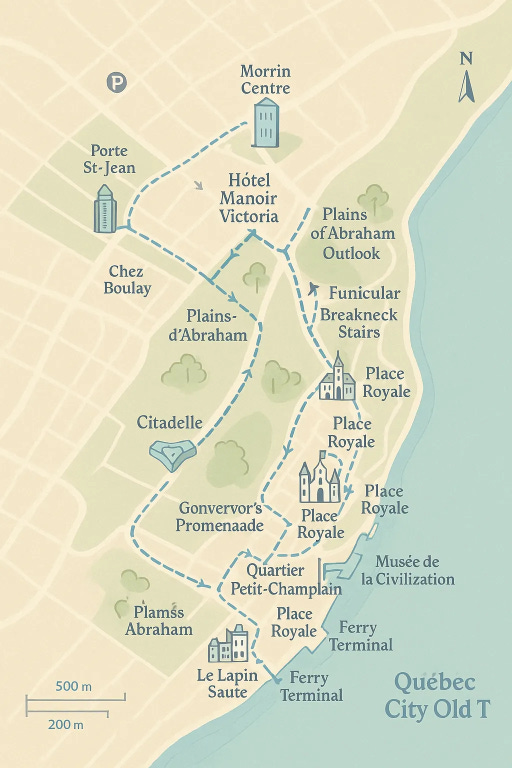
Ultimately maybe we need to reframe how we view intelligence. Rather than measure AI on traditional human measures of intelligence we need to start measuring AI on its ability to do the things we humans take for granted. The ability to spot basic map errors. To fold laundry. To clean the toilet. Less exciting, sure, but ultimately just as important.
PS this is the Udio song I mentioned upfront - the lyrics are a result of my son’s attempt to break WhatsApp by using an autoclicker to generate extremely long messages…
But perhaps I’m making the wrong comparison. Give a robot a guitar and you won’t get nice music. A broken guitar is a more likely outcome. So I’ve got an advantage - at least for now.
This may not be the most earth shattering observation of all time, but I am increasingly coming to the conclusion that AI is good (or at least acceptable) where “right” does not matter. Where “right” matters, it’s not.
There’s nothing “right” about producing a symphony - although great symphonies require all sorts of characteristics that meant a great one (and even a good one) eluded me when I was composing music. But as “right” is not a goal, AI can product perfectly passable ones, particularly that sound like all symphonies, ever.
However, when, say, the code has to work - as in not just compile but do the right thing 99.9999% of the time - AI simply cannot be trusted. Perhaps that day is coming, but I’m also increasingly sceptical, given what I see from Claude.
Perhaps if you throw super bucks at the problem, but I have yet to be convinced.
Speaking of which, I wonder how long before we see a sign post in this part of the world, in Welsh, saying “Claude here, how may I help you”…
Hi Martin, I was wondering if you would be interested in participating in our research about the future of AI in Creative Industries? Would be really keen to hear your perspectives. It only takes 10mins and I am sure you will find it interesting.
https://form.typeform.com/to/EZlPfCGm