
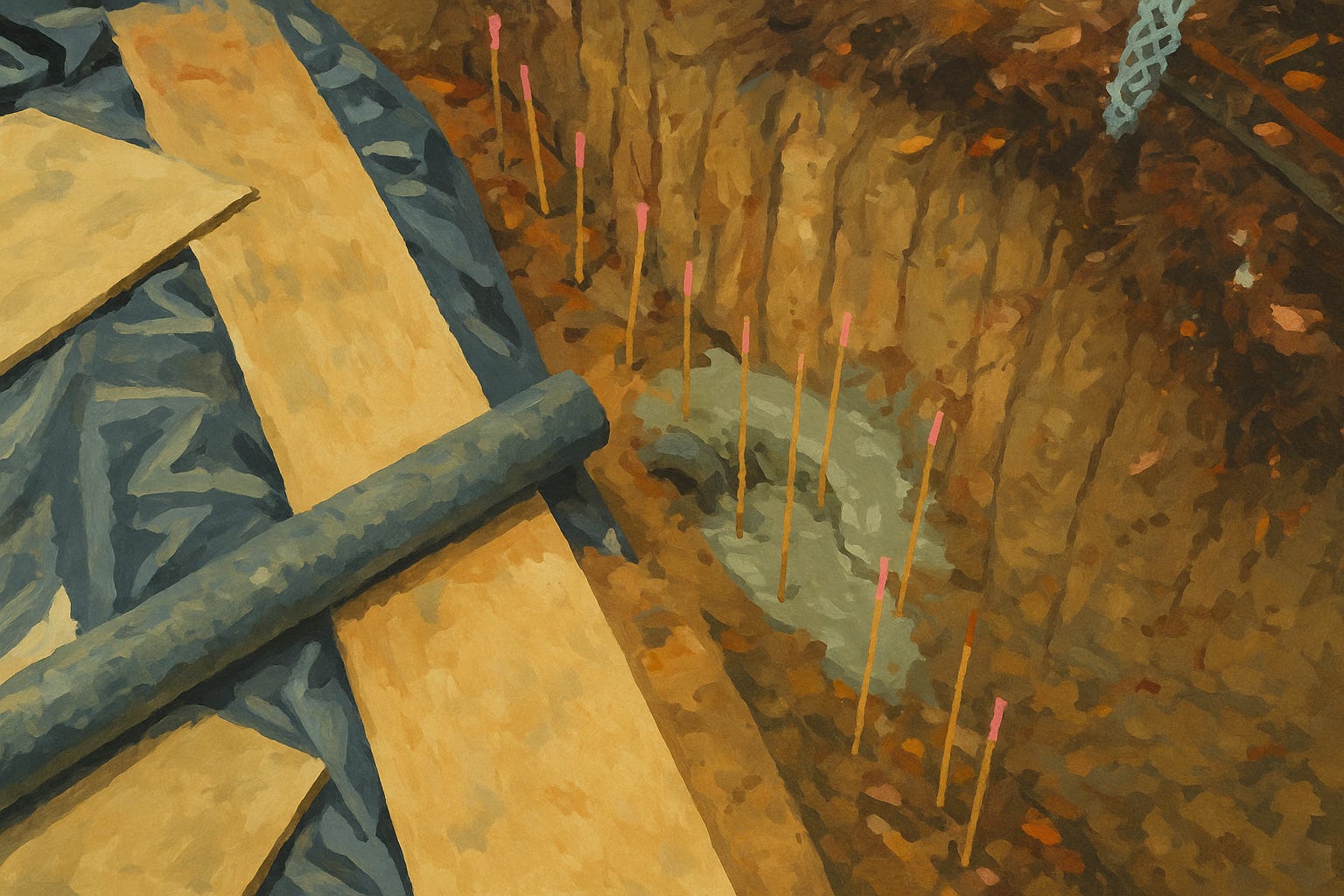
The sound reminded me of how a dragon’s hungry stomach might sound. A low pitched, ominous echoey gurgling. It started far off, but got determinedly louder as the dragon edged closer. But this was no dragon. It was a hose filled with concrete. Concrete that gurgled and spluttered as it drew ever closer to the end of the pipe and the foundation trench it would soon fill.
Less than an hour later, 5 cubic metres - 12 tonnes - of concrete was neatly finished in the trench. It all seemed too easy. But it was a good reminder of how the right tool can make light work of a difficult task. My site is 60m from the road. And 3m higher than the road. Using a wheelbarrow this would have taken 120 trips over 8 hours. And that’s with no breaks.
The concrete pump enabled me to do something I couldn’t have done as an individual.
AI is similar. It simplifies things that were previously difficult. Or impossible. There’s the obvious stuff - creating music, podcasts, videos, stories, programs. But in some ways the biggest change has been to up-level my skills in unfamiliar areas. Take my workshop project. I’m no master builder, so much of what I’m doing is new to me. But AI turns out to be a massively experienced builder who also has a great set of contacts.
AI researched options for pouring the concrete foundations. It found concrete suppliers and pump operators. It suggested using a volumetric mixer (which mixes the concrete onsite so you get the exact amount of concrete you need) and found a pump company who could pump 60m (some don’t go further than 45m). It designed the depth of the foundations. It designed the tanking for the rear wall (to make it waterproof). It designed the slab. It found endless building suppliers. The list goes on and on.
Now, I probably could have worked all this out by searching and chatting online. But it would have taken longer. And I’d have understood it less well. The ability to clarify things I’m unsure of is one of the things I like the most about AI - and I can keep asking questions until I understand.
So perfection?
This isn’t to say things didn’t occasionally go wrong. o3 tried to draw a picture to illustrate the junction between the slab and the wall. No, I don’t understand it either.
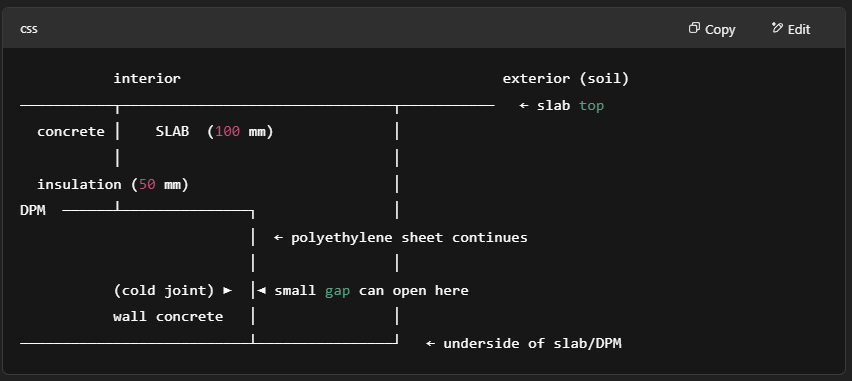
And we went down a blind alley of trying to take the waterproofing layer (called the DPM - Damp Proof Membrane) through the retaining wall. A neat idea, but, in reality, impractical to construct. That’s the kind of thing a real builder, with real world experience, would instantly reject as daft.
But these minor mis-steps aside, I realise how dependent I’ve become on AI. I wouldn’t want to give it up.
I’m not alone
At work, I’ve been running a trial of Claude. We’re nearing the end. One of the biggest concerns has been about whether we’ll get to continue using Claude after the end of the trial. I jokingly said we might not - and the looks of horror were clear to see.
It is striking how quickly I - and others - have become dependent on these tools. Two years ago I barely used AI. Now it’s an integral part of my life, almost important as electricity. It’s a troubling thought.
Like the concrete pump, the right tool for the job is transformational. But I only rented the pump for a day; with AI I’m integrating it into my life. Tightly integrating it. Without fully realising. And I know I’m not alone.
AI is now a part of my decision-making process. A foundational part.
And while there are hundreds of companies providing concrete throughout the world, there are only a handful providing AI foundations. In the top tier we have Anthropic, OpenAI, Google. Further behind there’s DeepSeek, xAI, Meta.
What happens when the right tool for nearly every job is controlled by such a small group of American (and one Chinese) corporations? When they can change pricing, access, or capabilities at will? When the "concrete pump" that makes your projects possible could be changed based on business decisions made thousands of miles away?
This is becoming more real. OpenAI are trying to increase pricing. Gently scaling back their current offerings with smaller capacity limits. They’ve also hired Fidji Simo who drove engagement at Facebook. I’ve previously written about the conflict between increasing engagement and good outcomes for humans.
Two weeks ago Google replaced Gemini with no warning - and broke a raft of applications. There are going to be many more bumps and bangs ahead.
Of course, this isn't our first technological dependency. We've been here before. Telephones, electricity, the internet. Each time, we've integrated so deeply that removing them becomes unthinkable. But AI feels different. Previous technological revolutions changed what we could do. AI is changing how we think, how we make decisions, how we create. The telephone changed how we communicated; not what we communicated. The internet changed how we found information; not the information.
AI feels different. It does change what we communicate. It does change the information.
But we can't abandon these tools. They are too valuable. We are too addicted. My workshop foundations are a concrete testament to the value they offer. But as we continue to pour concrete, we need to think what we're building upon. And who controls this essential infrastructure. What alternatives we need to develop. What we do when we discover our AI foundations are built on sand and not concrete.
For those of us here in Europe, this question is critical. We are rapidly building critical infrastructure on foundations we don’t control. The EU AI act effectively prevents concrete being mixed in Europe; we risk becoming permanently dependent on concrete mixed overseas with different values and priorities in mind.
I had choices for my concrete supplier. Europe increasingly doesn’t. Not when it comes to AI.
Digital sovereignty isn't just about where your data lives. It's about who controls the tools that shape how you think and work. It's about whether you can build what you need when the American or Chinese supplier changes their formula or raises their prices.
As I watched the concrete flow into my foundation trenches, I wondered: is Europe digging itself into a hole it can't escape? Creating dependencies that will be as permanent and inflexible as the concrete setting in my workshop foundations? And if so, what can be done while the concrete is still wet?