Paperclips and pylons
A budgeting lesson from a 1990s power company

When I was an intern, I worked for Scottish Hydro Electric. Yes, they were a Scottish electricity power company. And, yes, they had a lot of hydro power stations. It was a good name.
This was the early 1990s and the group I worked for had a fine collection of DEC Vaxstations. These were powerful workstations used to simulate - and control - the electricity grid. They weren’t cheap; prices started at £10,000 and went upwards rapidly. The group also had a single, solitary PC which was in high demand for writing docs and spreadsheets. But, being an intern, I was at the back of the queue so mostly used it at lunchtime and after 6pm.
But it seemed strange - a PC cost a tenth of the price of a workstation. Why did they only have one?

The answer was to do with budgets: the workstations came from the power station / transformer / pylon budget. A £10k workstation is nothing compared to a power station.
However, PCs were funded from a different budget. The stationery budget. A PC was outrageously expensive compared to a packet of paperclips.
Last week I was having lunch with a good friend. And this story popped into my head as they described how their company had introduced a new spending limit on AI. $20 per week. Yikes.
The problem is the labs shifting their enterprise plans to pay for what you use. There are no more all you can eat discounted plans if you are a proper company. It can get expensive quickly.
Or does it?
The problem is what are you comparing with. Office 365 costs from $10 per month per user. Add in all the bells and whistles (including $30 for Copilot) and it’s $99 per month. Visual Studio Pro costs $100 per month.
But it’s easy to spend $1,000 per month on AI for software dev. That’s expensive compared to existing "software" costs.
Trouble is, this is the stationery budget. The actual budget to compare with is the salary budget. And that’s a different number. The average US software engineer salary spend is $16k per month; the median US firm spends just $12 on AI per employee per month.
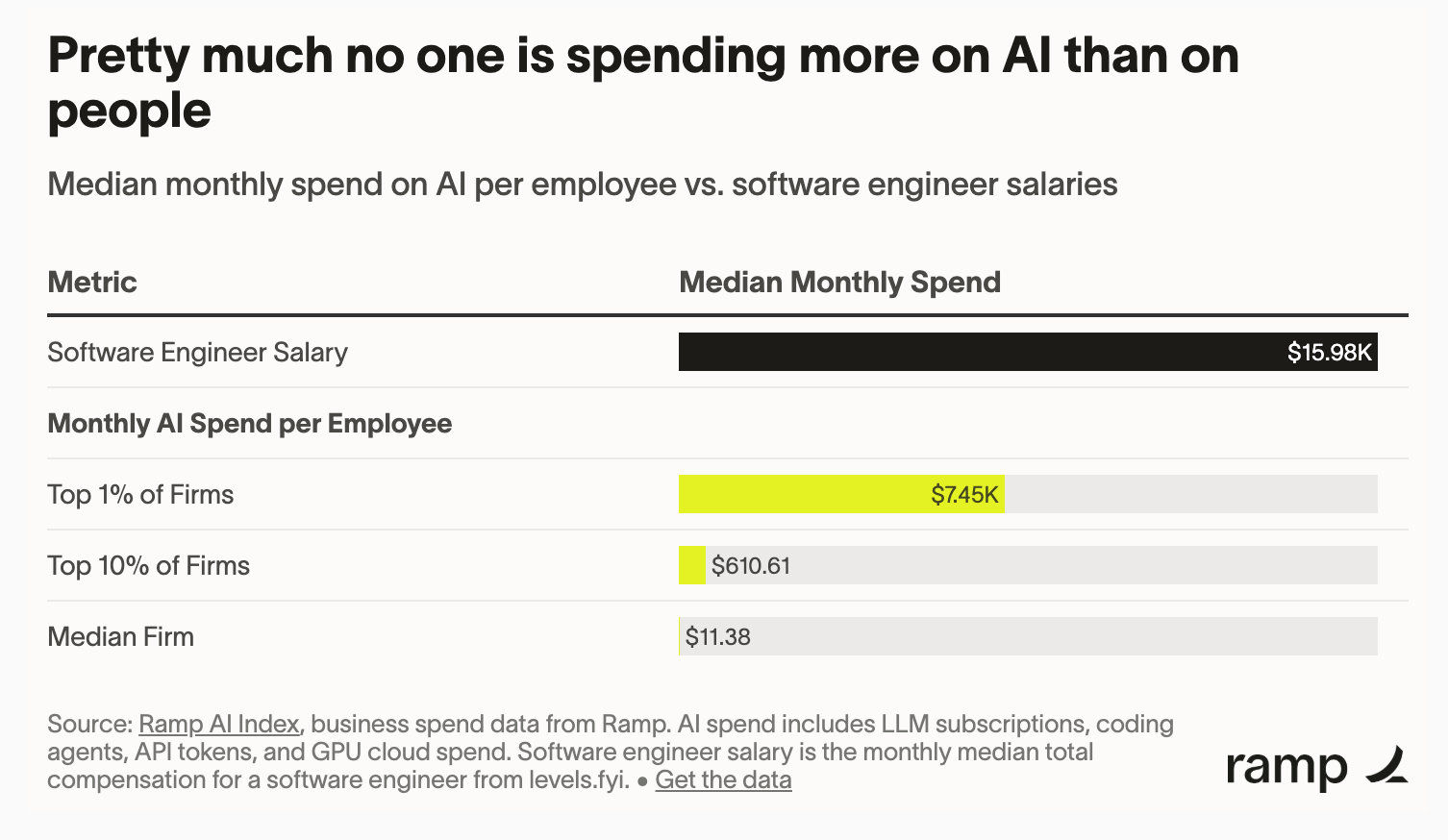
But this is a wildly skewed distribution. The top 1% of firms spend a bit under 50% of an engineer’s salary on AI: ~750x more than the median.
Then consider productivity. This is data from Anthropic.
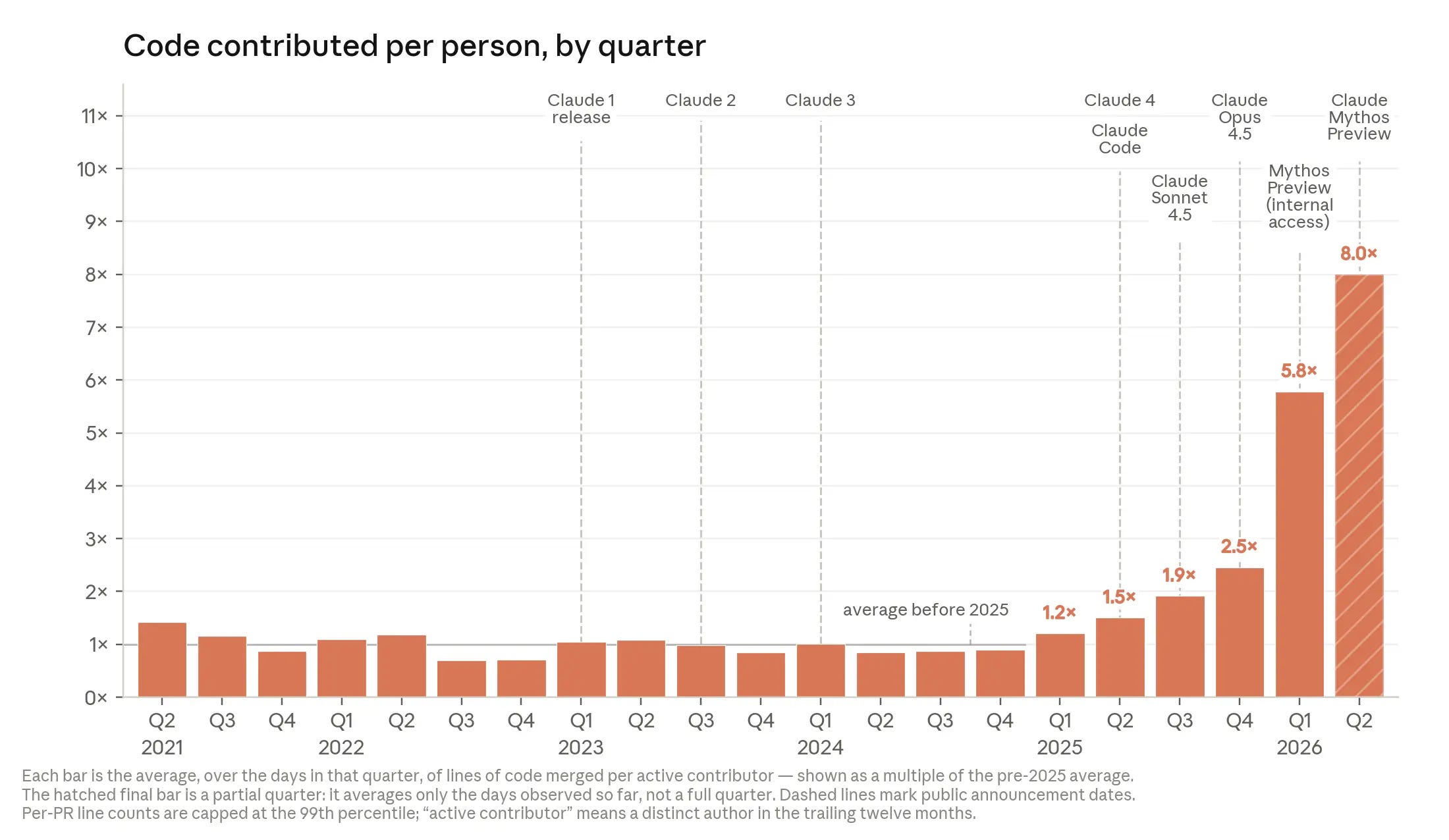
Now 8x more code per person per quarter does not mean 8x more productive. And this is Anthropic measuring themselves; there are vested interests at play.
But their conclusion does seem reasonable: "a significant fraction of Anthropic technical staff is accomplishing their core work multiple times faster than they could without AI assistance."
Not least because it matches my experience. Things that would have taken me weeks can now be done in a day. And things I never dreamed of being able to do (e.g. write a C compiler to compile Linux and run it in my Pentium emulator) are suddenly possible.
And so?
Done right, AI offers the opportunity to go multiple times faster. But "done right" is the critical phrase - taking advantage of AI requires rethinking processes, cutting fat (meetings, org layers) - reimagining the software development lifecycle.
That costs money. Perhaps it is not a surprise that most companies are reporting little to no benefits from AI. What do you expect for $12 per month?
There is a circular issue here. Getting the most from AI requires a serious investment. And it might not pay off immediately. But until you invest you are not going to see any return.
The irony is that the companies wincing at the price of AI actually have the money - fund the AI budget from the salary budget and suddenly it’ll seem cheap(er). I don’t know for sure but I suspect Scottish Hydro Electric no longer compares the price of a PC to a packet of paperclips…