My 2am epiphany
Was gaming until the early hours secretly preparing me for an AI future?

The clock read two minutes past two. A.M. Drat. I needed to get up in less than 5 hours. Why had I stayed up so late?
It was March 1995. Earlier that day I’d finally got hold of a copy of Transport Tycoon. Released the previous November, it was a transport simulation game. It was addictive. I’d spent the previous eight hours orchestrating a complex, interconnected world. Remarkably I still have the save game - and can still load it - here’s my game from earlier that evening.
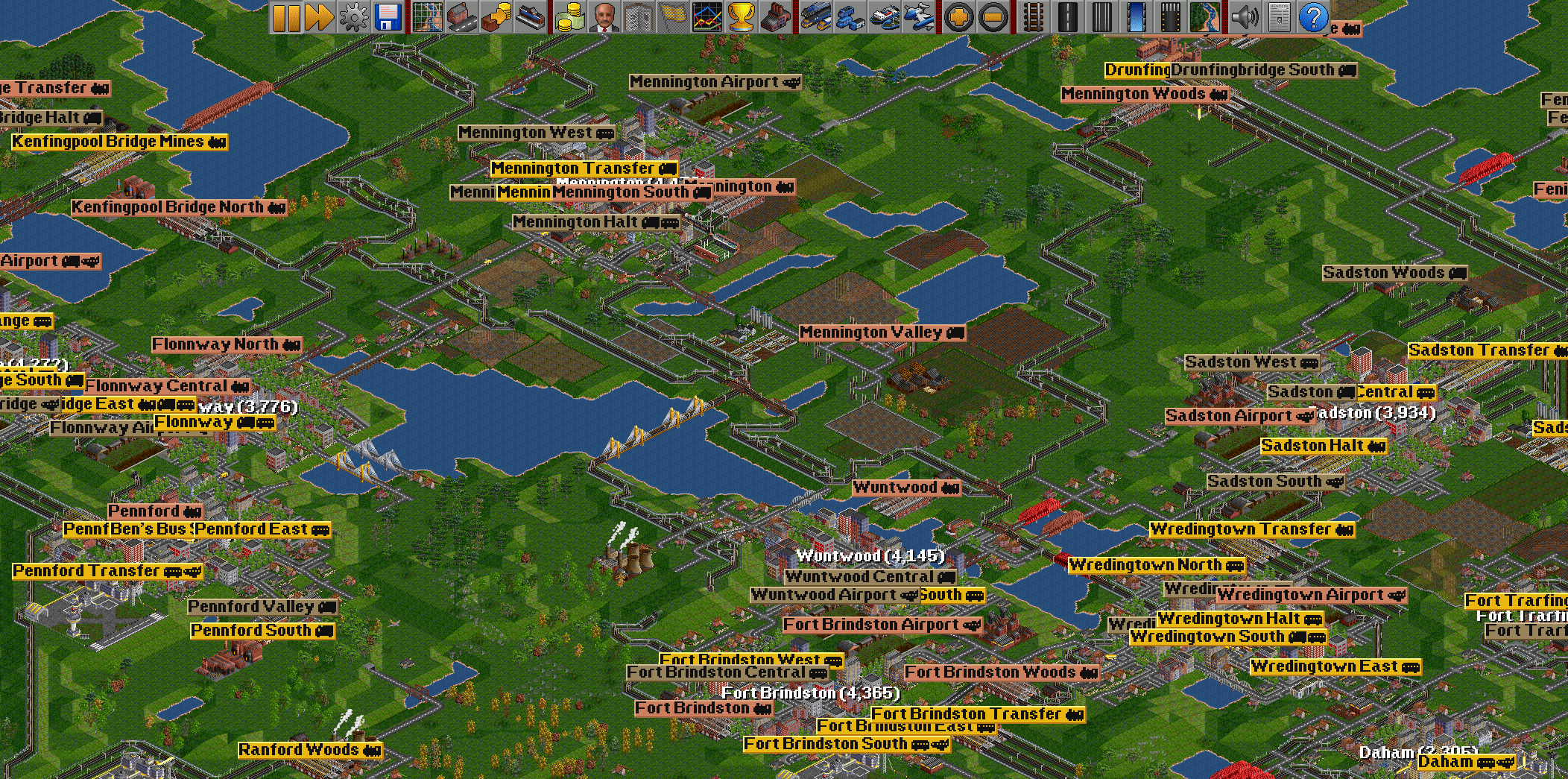
There had been management and simulation games before, but Transport Tycoon, with its colourful graphics and addictive gameplay, helped popularise the genre. Modern games such as Factorio, Cities In Motion, even Stellaris owe much to early pioneers like Transport Tycoon.
A defining characteristic of these games are pipelines. In Transport Tycoon you take iron ore from a mine to a mill to create steel. Then take the steel to a factory to produce goods. Then take the goods to a city. Modern games dial this up. In Factorio, iron ore is converted to iron plates to iron gear wheels to engine units to mining drills to science packs.
And AI is a bit like this. Take the podcast process I wrote about last week. It’s just another pipeline.
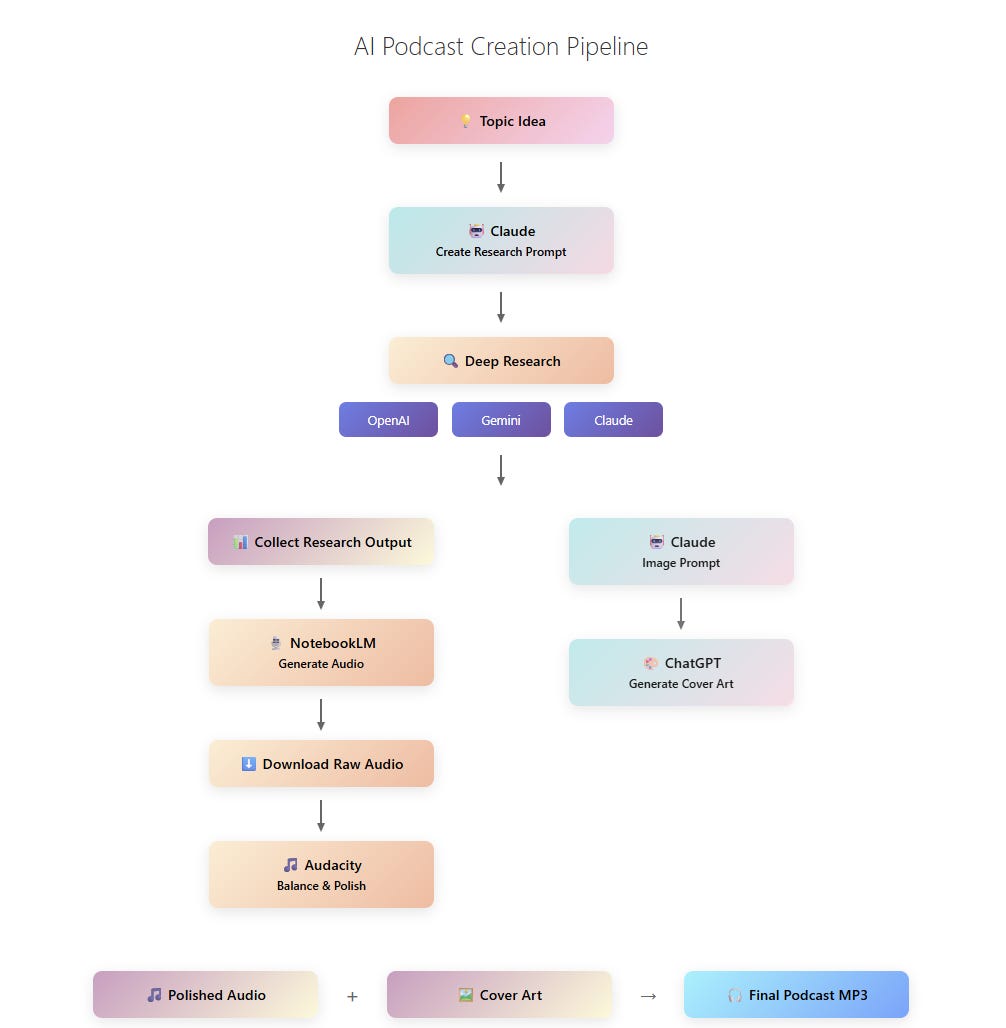
In Transport Tycoon I didn’t need to know how to mine iron ore, or convert it to steel, or turn it into goods. And in the AI world I don’t need to know how to research a subject, or turn it into a podcast, or paint the cover picture.
What I do need to know is how to connect the steps together. What order to connect them in. Just as I needed iron ore before I could make goods, I needed a research prompt before I could create a podcast. These days games come with flow charts showing the pipelines. But, back in 1995, I had to work them out myself. Just like I have to do today with AI - there are few paved paths to copy.
Leveling up
When I first played Transport Tycoon, I built simple point-to-point routes. One train, two stations, coal to power plant. Done. But as I got better, I created increasingly complex networks, trying to avoid bottlenecks (and train crashes).
And my AI journey has been similar. I started with single, isolated prompts. Simple inputs, simple outputs. But over time, I've figured out how to create sophisticated chains: using Deep Research to generate material, passing that to Claude to summarise, sometimes converting it into a video with Sora or a podcast with NotebookLM.
Figuring out how to plug the tools together is what matters.
Optimising
Every Transport Tycoon veteran knows there's a game beneath the game. It's not just about building functional routes, it's about optimisation. Finding the perfect signal spacing. Designing station layouts that minimise train waiting time. Avoiding train crashes (no level crossings, thank-you very much).
Working with AI has its own meta-game. Some prompts work better for some models. What model is best for which task. There’s no one size fits all. Claude, o3 and GPT-4o are all part of the rotation.
Keeping the pipeline full
Another similarity is feeling constantly busy. When you are playing these games there’s always something else to do. You are constantly monitoring existing pipelines, tweaking and adjusting. At the same time you are building new pipelines. That’s part of the reason the games are hard to put down - you are never done.
AI is spookily similar. There’s always something else you can build. Some times I find myself madly plate spinning. On one desktop I’m prodding udio along to make music; on another Sora is creating video clips; on another Deep Research is creating podcasts. It’s not exactly, err, relaxing. And then, occasionally, I’ll lose the thread and the plates will come crashing down.
Blueprint libraries
As Transport Tycoon evolved, people created and shared blueprint libraries and automation tools. Standard junction designs. Pre-optimised station layouts. Signal patterns.
Similar things are starting to emerge for AI. And we’ll see more as people build internal prompt libraries and share best practice. This will get encoded into the models - and may even be the foundation of the agent revolution currently being hyped.
But just as the best gamers understand the underlying mechanics rather than blindly following blueprints, those who really understand will maintain an edge. They'll know when to customise, when to optimise, and how to troubleshoot.
And so?
What does this all mean for our future? It feels like we’re moving from a world where knowing how to do matters less. Instead, knowing how to connect will matter more. We’re moving from being individual content creators to orchestrators.
There will still be value in understanding the underlying skills, but less so. I no longer need to know how to research or create a podcast or code simple web-apps. What I do need is systems thinking. How to visualise and optimise multi-step workflows. Increasingly that meta-skill matters more and more.
Could it be that my kids, who spend hours on games such as Stellaris and Factorio, are building the skills that will enable them to thrive in the new AI world? That their free time activities are teaching them more than the hours at school?
And for me? Well, maybe it’ll turn out that staying up until two was the right decision in the long run. That would be a strange outcome.
I loved that game! I remember that there was no fast forward in the original so I'd leave the game running over night to progress 2-3 years game time. Music was great, but our first PC didn't have a sound card so I originally played it in silence, jealous of my friend's descriptions of the audio 😄.
And I have to take this opportunity to plug the following excellent account through computer gaming’s history:
https://www.filfre.net/2020/10/transport-tycoon/
Great, thanks for putting Transport Tycoon music in my head. Again.