
Over the years I’ve been called many things. Some of the more acceptable have been "team lead", "manager", "second line manager" (we’ll gloss over the less acceptable ones…).
Lots of leadership-y roles. I enjoy the capacity step a team brings; a group can get so much more done than any individual. Plus there’s the buzz from seeing what others have built.

There’s also the part of setting goals, having visions :), and steering the team. A big part of this involves talking to people - and getting them to talk to each other. Over the years we’ve discovered daily stand-ups are an effective way of sharing context within teams. Just enough context sharing and not too much bureaucracy. And when people need to talk more frequently they do - two engineers working on either side of an API discuss the shape and agree the interface before implementing the internals.
It’s a way of working I’ve been trying to get my AI team to adopt for a while. But with mixed results. Until last week.
Can models lead?
Fable 5.1 was the first model which really showed some leadership chops. It was happy to direct a team of 1-5 agents without jumping in and trying to do the work itself (something earlier models were prone to). It would run for days driving a dynamic team - with agents spinning up and down as required.

Fable could also message other agents. But the conversations seemed fairly stilted - question, answer, done.
Of the other models? Opus 5 was smart. And efficient. But it was pretty much a bust at leadership. Nor could it communicate to humans. GPT-5.6? It was better at the communication. But it didn’t show much desire to delegate.
But Opus 5.5?
It’s an incredible leader (perhaps it read Jon Berger’s book on leadership?). Much better than anything that has come before.
Take yesterday. I was reviewing the architecture of one of our products. It has, erm, evolved. We didn’t really understand the problem space when we started building it. And while the architecture is plausible, it’s not ideal.
So I did the classic, "knowing what we know now, how would we design this?" And Opus 5.5 and I set to work writing our architecture diagram and core flows along with the high level reqs.
Predictably, this revealed we had some solid components. And other weaker ones. And the framework they plugged into was, well, grunky.
So we set out to redesign and broke the architecture up into about ten separate blocks.
All pretty normal so far. But then magic happened.
I made the Opus session I’d been working with the lead (let’s call it Bob). Then I created five other sessions, named them (AAA, AAB, AAC etc), and told Bob about them. Bob then proceeded to divide up the work, message the other agents with their briefs and set them to work. Each of those agents then spun up their own teams of subagents to do the work while talking back and forth with Bob.
My kit is all in a mesh network; any agent can use resources on any other machine via ssh. The infra publishes the specs of the kit. Bob went and found out what kit we had and then, after checking with me, assigned different machines to each of AAA, AAB etc. Err, OK.
I watched as the agents agreed interface specs with each other. Shared status. Flagged build-breaks. Fixed issues. How Bob collected issues and questions from the team, prioritized them and raised them with me. How Bob didn’t forget things; if I hadn’t answered something it reappeared at the bottom of the trail for me to deal with.
Bob hasn’t stopped - they have been busy co-ordinating, sync’ing the team, reporting status. It’s weirdly addictive to watch.
We started at about 4pm yesterday. The team has been running all night and all day. We are getting close to being done. This is a massive rewrite of the core of our product. 100kloc. Time will tell how well it worked, but from the experiments I ran last week I’m pretty confident we’ll be OK.
It’s not just leadership
You’re probably familiar with my emulator. The story arc has taken us from Tetris through Formula One Grand Prix to Doom to Quake and to Colin McRae Rally (CMR). DOS through Win16 through Win32. After we got CMR working we moved onto Half-Life 2 (HL2).
CMR is a game from 1998. It required a Pentium 166MHz and 16MB RAM. HL2, on the other hand, is from 2004 and needs a 1.2GHz Pentium IV and 256MB RAM. Remarkably, the version of the emulator that ran CMR at 60fps could also run HL2 (after adding support for DirectX 9).
But at 3fps.
That was August 13th. A month later, GPT5.6-Sol had got to 7.2fps. Then Astra and Fable 5.1 had a go; last Tuesday it sat at 12fps.
This is a genuinely hard problem - it requires building a dynamic optimizing re-compiler (DRC) to convert X86-32 into ARM instructions. Detect the hot regions, recompile them, cache them. It’s the kind of thing that takes large teams of engineers years and years to do well.
On Tuesday night I got Opus 5.5 working on improving the frame rate. Care to guess where it is now?
35fps.
One measure of the effectiveness of a DRC is the host/guest instruction ratio - i.e. how many host (in this case, Arm) instructions are required for each guest (X86-32) instruction. The ratio is much more than 1:1. Guest memory accesses need address translation and protection checks. x86 condition flags don’t map nicely onto Arm. And then the emulator has to model all the hardware and underlying software too. Graphics, sound, timers, Win32, Direct3D. HL2 manages a ratio of ~25 host instructions on ARM; on Windows its ~17.
Putting that in comparison, QEMU, which has had decades of optimisation hits 68 when running DOS Quake; we need 50.
Which is not to say it’s perfect. There are smells of Goodhart’s law. For FastDoom on DOS the ratio is 160. So we seem to have optimized well for HL2 & Quake but not more generally.
Still. This is a week of Opus 5.5 compared to six weeks of the previous models. I thought the other models were doing well when they found a gain of a few percent; now that seems, well, agricultural. Watching Opus 5.5 has been addictive. And scary. This was meant to be really hard. Is this what an exponential feels like?
Oh, and Opus 5.5 also built a DRC for x86-64 as well. That hits 74fps and has a host/guest ratio of ~17. FFS.
The list goes on and on. Another Opus 5.5 team fixed a whole set of bugs in my languishing Win16 emulation (where you run "mdpc <old-application exe>" and that old app appears on your desktop, complete with all the original window chrome, fonts, controls etc). So many bugs fixed. Message ordering. Graphical glitches. Random crashes. Font mapping.
Here’s FreeCell, WinFract, Word2.0 and CMR all running together.
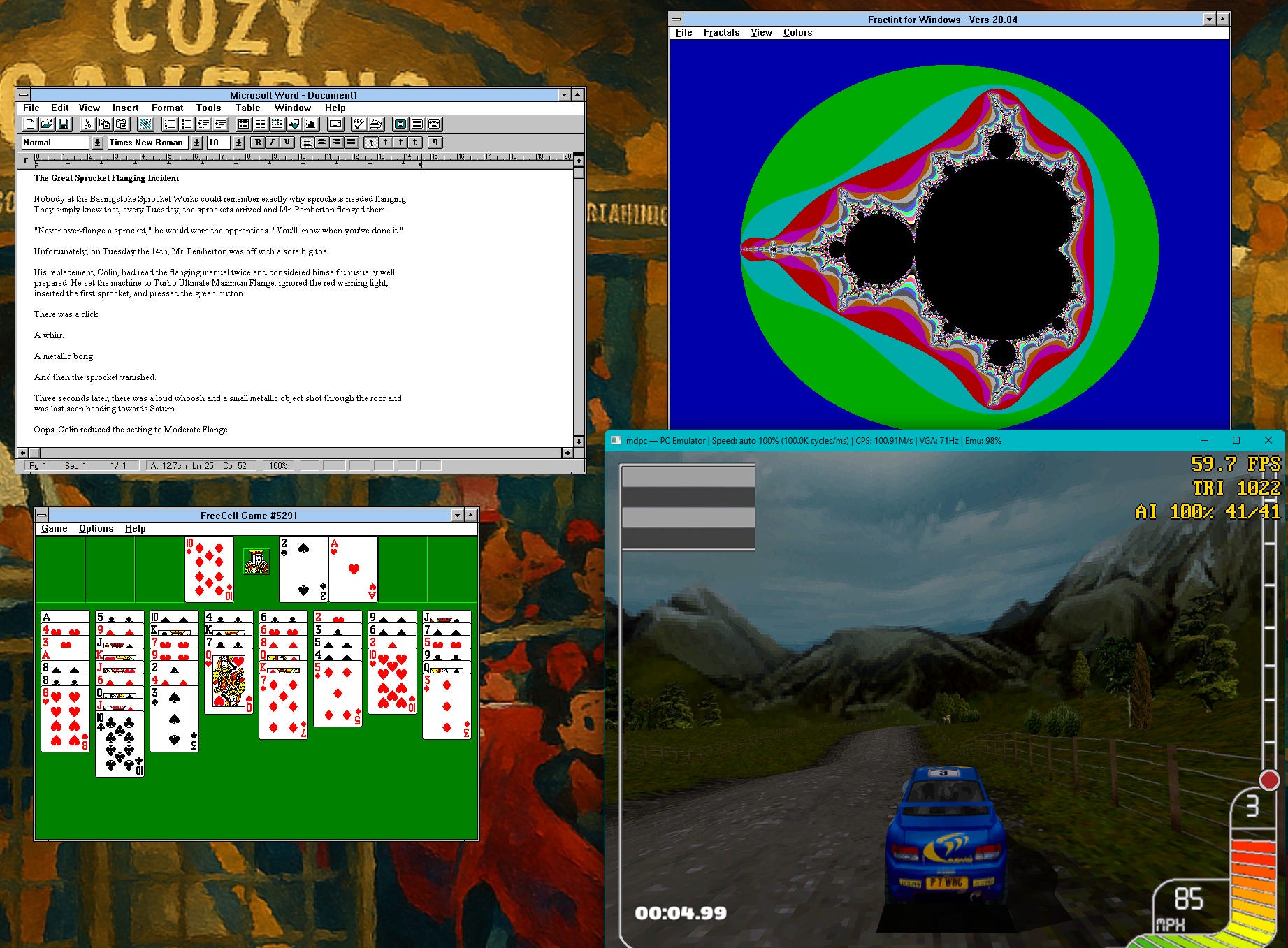
Opus 5.5 is not just a great leader. It’s a smart techy too.
And so?
Where does this leave me? It seems, like it or not, I’ve been promoted. Or maybe edged out. My job now seems to be CPO/CTO. My team don’t need me to do much of the organization I did before. And they can run faster. So I find myself running faster to keep up. Because I can have as many Bobs as I can keep busy.
I’m not sure how I feel about all this. On the one hand, it’s addictive to be able to build things so fast. But, boy, keeping up is hard. I’ve not slept nearly enough in the past week. My kit is working harder than ever; my study is roasting. I worry that if anyone pointed a thermal camera at my house they’d think I was running a cannabis farm. I wear a t-shirt in my study and put a jumper on when I venture into the rest of the house.
Right now this change is OK - our company is small enough that we can adapt. Being able to do more, faster is beneficial. But if you’re a techy in a normal company? Your value was already diminishing - and this accelerates it. I can’t see us ever hiring a traditional software engineer. Which is a weird thing to write.
When I first started work I joined a company called Data Connection. Back then it had about 100 engineers. In terms of output, my AI team was comfortably beyond that before last Tuesday. And the gap keeps growing.
Data Connection was a great place to work; I had a lot of fun and got to work on some amazing products. But that way of life is coming to an end. The career I started out on is going the way of so many before it. As excited as I am about Opus 5.5, I can’t help but feel sad as I watch the imminent demise of traditional software engineering…